

Accents, bidialectalism, the bilingual lexicon, fair assessment: Caroline Floccia’s four seminars (University of Plymouth) are now online, in English.
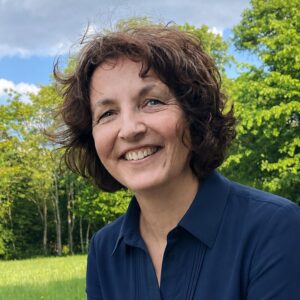
Photo: University of Plymouth
Can a five-month-old baby tell two accents of its own language apart? Does a child growing up with two languages build their vocabulary like other children? And how can we assess their language without measuring it against norms designed for monolinguals? These are the questions explored by Caroline Floccia, Professor at the University of Plymouth (UK). Invited as part of the EFL International Chairs programme, she was hosted at the Laboratoire de Linguistique Formelle (LLF) from 2 May to 1 June 2026. Her four seminars were filmed and are now available online.
A series on variation in language acquisition
For decades, language acquisition was often studied as if children grew up with a single language, spoken in a single standard form. Real-life exposure is far more varied: many children hear several languages, accents and dialects. In this series, Understanding Language Development Across Variation: Multidialectal and Multilingual Children, Caroline Floccia reviews what we know about language development in these settings, from both psycholinguistic and clinical perspectives.
Director of the Plymouth Babylab, she has spent more than twenty years studying children exposed to several languages or dialects. 👉 Her page at the University of Plymouth
Seminar 1 — The role of accent in early language acquisition and perception (Part 1)
What exactly is an accent, and is a regional accent processed like a foreign one? This first part sets out the definitions and key concepts, then looks at how adults perceive and recognise words spoken in an accent that is not their own.
Seminar 2 — The role of accent in early language acquisition and perception (Part 2)
The second part moves from adults to infants and young children. First question: can children tell accents apart, and does an accent help or hinder word recognition? At five months, babies in south-west England already distinguish their own accent from a Welsh one, with speech rhythm apparently playing a key role. Around age five, children set foreign accents apart, but not yet regional ones. According to Caroline Floccia, the two types of accent are processed differently from the second year of life.
Second question, still little studied: what does bidialectalism — growing up hearing several accents of one’s native language — change? These children seem to accept more variation in pronunciation. Whether their sound representations are less precise, or whether they simply tolerate more variation, remains open: ongoing studies should help settle the question.
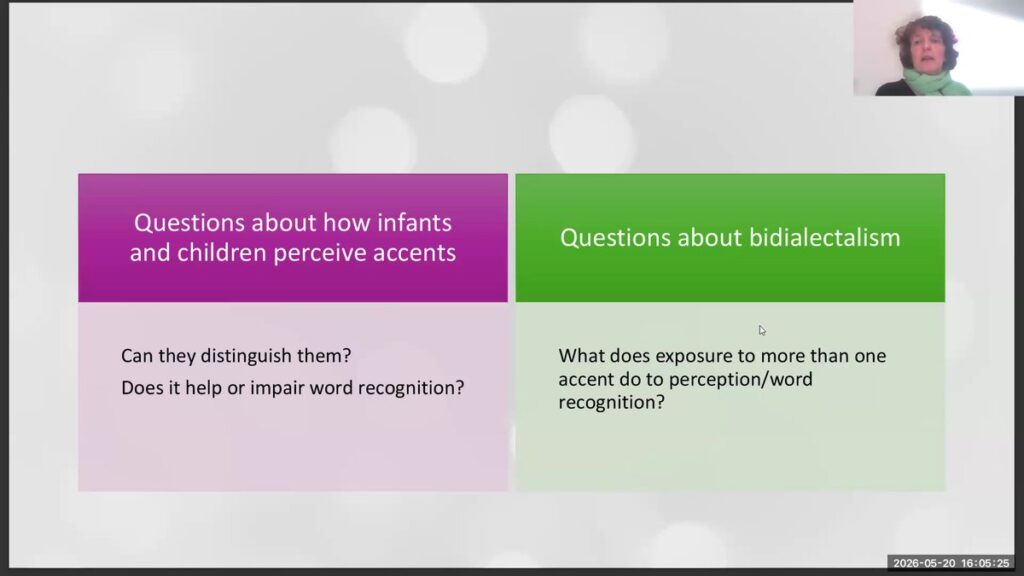
Seminar of 20 May 2026
Seminar 3 — Word acquisition and bilingual lexical organisation
How do bilingual children build their vocabulary in each language? The seminar presents priming tasks used to study word access, along with recent findings on processing speed and on the roles of proficiency and exposure.
Seminar 4 — Assessing bilingual children fairly
Language tests are often normed on monolingual children. Caroline Floccia shows the limits of these norms and their cultural and linguistic biases, presents tools adapted to bilingual populations, and explains how to take language exposure into account when assessing development.
Further reading and viewing
Seminars in English. The series contributes to three EFL research themes: Growing up, growing old: language processing throughout life, Bilingualism, multilingualism and contact languages and Language variation and change.
👉 The other 2026-2027 International Chairs
👉 All EFL videos on YouTube