

Language variation and change
All languages vary over time, across countries, across speakers.
Increased language contact in a globalized world yields both more standardization and faster spreading innovations. Thanks to the Internet and smartphones, more and more languages are written, and we have access to more informal, and spontaneous uses, which are goldmines for linguistic research on language variation and change, and put us in a better position to compare formal and informal language use in both spoken and written modalities.

Understanding and supporting linguistic variation.
Like patterns in constant motion, linguistic practices trace a fluid map of how we speak, evolve, and locate ourselves. Language changes—and that change follows its own laws, rhythms, and tensions.
© Photo de Alexis Caso @ Pexels
Presentation
This workpackage will address big questions such as: Are languages shaped by universal properties of the brain (Bickel et al 2015) or the articulatory system (Dediu et al., 2021), by universal principles of communication (Futtrel et al. 2020) or by culturally driven tendencies that happen to spread locally in specific regions or lineages?
Building on previous results from strand 1 (Phonetic and phonological complexity) and strand 2 (Experimental grammar in a cross linguistic perspective) of the labex EFL, it will deal with both synchronic and diachronic language variation and change, across languages and within a particular language, with a large span (macrovariation) or a short span (microvariation), using cutting edge quantitative methods, large corpora and experiments.
Projects focusing on diachrony include phylogenetic evolution and language diversification, word order evolution across centuries, and sound evolution in the past 50 years. For social variation, we will work on speaker specific phonological contrasts as well as syntactic variation in French (across countries and centuries) and the role of normative pressure (verbal hygiene). For regional and areal variations, we will look at the role of language contact in language change, including tonal or non-tonal systems in Sino-Tibetan languages, gender marking in various Indo-European and Papuan languages, syntactic variation (discourse marked constructions in European languages), and semantic variation (TAME in Australian languages).
Building on the complementary expertise of phoneticians, syntacticians, semanticists from thirteen research labs working on more than a hundred languages, we will document phonetic, lexical, syntactic, semantic variation (areal, regional, speaker/listener-specific, etc.) across a variety related and unrelated languages, and explore how they are triggered by language contact, by language structures (internal, prosodic, syllables, morphemes, informational structure, etc.), by physiological factors (speaker-specific details, coarticulation), by social factors (gender, age, education, occupation, origin, social status, prestige, communities), modalities (oral, singing, sign, written), registers and genres (formal, informal, public, private, forensic). We will also explore the social meaning of some variants, and compare changes from below and changes from above.
Roadmap
On top of scientific publications, this work package will produce new resources (database and annotated corpora) for language diversification, phonetic evolution, syntactic variation and semantic typology. It will organize international conferences (CSSP in 2025, 2027, 2029; UltraFest in 2026 in Paris) and summer school (Experimental grammar in 2026 and 2028); we will hire Phd students and postdocs with cofunding from ANR and European projects.
List of projects
1. Language variation and change in diachrony
Project 1.1 Phylogenetic models of language evolution and diversification
Leads: Guillaume Jacques (CRLAO); Thomas Pellard (CRLAO)
Historical and comparative linguistics seeks to describe and explain the evolution of languages and their diversification processes. With new mathematical models and phylogenetic inference, we aim to quantify diachronic changes, push the temporal limits of reconstruction, and improve the reliability of reconstructions and dating, for lexical features, as well as phonetic, morphological and syntactic ones.
Permanent members: Marc Allassonnière-Tang (EA); Anton Antonov (CRLAO); Isabelle BRIL (LACITO); Anne Daladier (LACITO); Alexandre François (LaTTiCe); Rozenn Guérois (LLACAN); Dmitry Idiatov (LLACAN); Sylvain Loiseau (LACITO); Amina Mettouchi (LLACAN); Nicolas Quint (LLACAN); Guillaume SEGERER (LLACAN); Maria Zimina-Poirot (ALTAE)
Non-permanent members: Guendalina Gianfranchi (PhD, LLACAN); Yuanhao Yin (PhD, CRLAO); Zhenyang Liu (PhD, CRLAO)
Project 1.2. Quantitative and contrastive approaches to word order diachrony
Leads: Pollet Samvelian (Lattice); Sophie Prévost (Lattice)
We will address a much-debated question in historical typology, namely the “natural” evolution of languages from SOV to SVO order, whereas the reverse evolution could only occur in the case of intense contact, using large syntactically annotated corpora, for French and Armenian, which went from SOV to SVO, and two Iranian languages (Persian and Sorani Kurdish) which evolved in the opposite direction.
Permanent members: Marc Allassonnière-Tang (EA); Anton Antonov (CRLAO); Lena Borise (LLF); Franck Cinato (HTL); Mathieu Dehouck (LaTTiCe); Anaid Donabedian-Demopoulos (SeDyL); Victoria Khurshudyan (SeDyL)
Non-permanent members:
Project 1.3 EDISON (Emergence of DIachronic SOuNd evolution)
Leads: Cedric Gendrot (LPP); Bowei Shao (LPP)
This project will examine how language sounds change over time, and whether some changes remain circumscribed within the system and eventually disappear, while others may lead to categorical linguistic change. We look at recent diachrony and explore large corpora using digital methods with fine-grained phonetic and linguistic analyses, with a focus on Romance and Slavic languages, as well as Georgian and Mandarin. Simulation of recurrent sound changes in the lab will examine the role of perceptual and articulatory biases, exemplar-based, and structure-based factors.
Permanent members: Martine ADDA-DECKER (LPP); Pius Akumbu (LLACAN); Angelique Amelot (LPP); Anton Antonov (CRLAO); Nicolas Audibert (LPP); Katia Chirkova (CRLAO); Ioana Chitoran (LLF); Emmanuel Ferragne (ALTAE); Jiayin Gao (LPP); Dmitry Idiatov (LLACAN); Hannah King (ALTAE); Sylvain Navarro (ALTAE); Thomas Pellard (CRLAO); Claire Pillot-Loiseau (LPP); Nicolas Quint (LLACAN); Rachid Ridouane (LPP); Shigeko SHINOHARA (LPP); Naomi Yamaguchi (LPP)
Non-permanent members: Carole Millot (PhD, LPP); Juliusz Cecelewski (PhD, LPP); Suyuan Dong (PhD, LPP); Jingyi Sun (PhD, LPP); Xiang Yunzhuo (PhD, LPP)
2. Speakers in society: individual and social variation and change
Project 2.1 Exploring speaker specific variation in production.
Leads: Emmanuel Ferragne (ALTAE); Giusy Turco (LLF)
This project aims at examining inter- and intra-individual phonetic/phonological variation. Whether this variation is partly deliberate (e.g., speakers may use it to signal their affiliation to a particular community) or occurs as a consequence of other factors (aging, various pathologies, code switching), we will be modelling acoustic and articulatory variation using tools such as EMA, MRI and EEG. While not excluding other languages, we will mainly focus on French, English, and Mandarin. Potential outcomes of our research include new methods for speaker normalization, a better understanding of the phonetics of automatic speaker identification in a forensic context, or the modelling of fine-grained acoustic cue, especially in bilingual speech.
Permanent members: Martine ADDA-DECKER (LPP); Pius Akumbu (LLACAN); Marc Allassonnière-Tang (EA); Jalal Al-Tamimi (LLF); Nicolas Audibert (LPP); Katia Chirkova (CRLAO); Ioana Chitoran (LLF); Cécile Fougeron (LPP); Jiayin Gao (LPP); Cedric Gendrot (LPP); Anne GUYOT TALBOT (ALTAE); Anne Hermes (LPP); Hannah King (ALTAE); Sylvain Navarro (ALTAE); Claire Pillot-Loiseau (LPP); Rachid Ridouane (LPP); Naomi Yamaguchi (LPP); Hiyon Yoo (LLF); Franck Zumstein (ALTAE)
Non-permanent members: Chenyu Li (PhD, LLF); Sana Saidi (M1, LLF)
Project 2.2 Syntactic variation and normative discourses in French
Leads: Anne Abeillé (LLF); Florence Lefeuvre (CLESTHIA)
Syntactic variation in French is usually underestimated, compared to lexical and phonetic variation. We will document it using spoken and written data, in diachrony (with private letters from 17th and 18th centuries), with specialists of Belgium, Quebec, the West Indies, the Indian Ocean and francophone Africa.
We will study new grammatical constructions, and question the gap with grammar books and normative discourses. We will use written and spoken corpora and provide quantitative analyses.
We will also set up experiments to study the processing of non standard structures, such as relative clauses with a resumptive pronoun (un truc que j’en ai besoin), or embedded in situ questions (je sais c’est qui), with new experimental techniques such as self paced listening.
Permanent members: Claire Badiou-Monferran (CLESTHIA); Lucie Barque (LLF); Myriam Bergeron-Maguire (CLESTHIA); Heather Burnett (LLF); Beatrice Dal Bo (CLESTHIA); Huy-Linh Dao (CRLAO); Caterina Donati (LLF); Martial Foegel (LLF); Guillaume Fon Sing (LLF); Aude Grezka (LIPN); Clive HAMILTON (ALTAE); Pascal Somé (ALTAE)
Non-permanent members: Claire de Mareschal (postdoc, CLESTHIA); Mariem Abid (PhD, CLESTHIA); Yijin Choi (PhD, CLESTHIA); Oks Lion (PhD, LLF); Tu Nguyet (PhD, CLESTHIA); Yuanlong Peng (PhD, CLESTHIA); Lea Robin (PhD, CLESTHIA); Lee Seul (PhD, CLESTHIA); Madoka Tanizawa (PhD, CLESTHIA); Guillaume Lorton (M2, CLESTHIA); Philippe Marchal (M2, CLESTHIA)
3. Language variation and change within languages and across language families
Project 3.1 Grammatical and social gender: variation and change
Leads: Maria Candea (CLESTHIA); Anne Abeillé (LLF)
We will study the typology of grammatical gender systems in a variety of languages, as well as the referential biases associated with grammatical genders. The relationship between social and grammatical gender will be under a comparative focus. We will also deal with recent evolution in 21st century of Western languages with critical discourse analysis and prescriptions for a less androcentrist communication and for mitigating strategies of biases.
Languages under investigation: French, English, Spanish, Italian, Romanian, Greek, Polish, Portuguese-based and French-based Creoles, Croissant dialects, Bantu languages, other Niger-Congo languages (Nyun, Koalib, Manjaku, Werni).
Permanent members: Marc Allassonnière-Tang (EA); Olivier Bonami (LLF); Heather Burnett (LLF); Martial Foegel (LLF); Clive HAMILTON (ALTAE); Dmitry Idiatov (LLACAN); Tatiana Nikitina (LACITO); Nicolas Quint (LLACAN); Gbriel Thiberge (LLF/ALTAE); Mark Van de Velde (LLACAN)
Non-permanent members: Guendalina Gianfranchi (PhD, LLACAN); Justin Jacobs (PhD, CLESTHIA); Rameh Jana (PhD, LLF); Emma Kious (PhD, LLF); Nina Nusbaumer (PhD, LLF); Suzanne Patzschke (PhD, CLESTHIA); Magdalena Borysiak (M2, LLF); Valeriia Zrivets (M2, LLF)
Project 3.2 Meqtame: experimental and quantitative methods on tense, aspect, modality and evidentiality markers
Leads: Patrick Caudal (LLF), Rozenn Guérois (LLACAN)
The project will aim to apply experimental and quantitative approaches to under-documented languages, in order to produce high-quality data and innovative empirical generalisations on time, aspect, modality and evidentiality (TAME). In terms of fieldwork, it will endeavour to use mainly recent experimental methods (from contextualised questionnaires à la Vander Klok (2022), to MPI-type storyboards, to experimental protocols using tools such as eye-tracking or EEG). In terms of quantitative approaches, the project will develop annotation schemes that are as general as possible (and that can be used in comparative/typological approaches), in order to build up semantically annotated corpora for TAME in under-described languages, in particular endangered languages, understudied language varieties, and ancient diachronic strata of any language. The operation will also evolve by broadening its empirical base (by also looking at phenomena related to TAME-related categories, such as space, post-modality (Caudal 2023), apprehensivity (AnderBois & Dąbkowski 2020), associated movement and posture (Enfield 2002) etc.).
Permanent members: Evangelia Adamou (LACITO); Isabelle Bril (LACITO); Agnès Celle (ALTAE); Jiyoung CHOI (CRLAO); Huy-Linh Dao (CRLAO); Karen De Clercq (LLF); Carmen Dobrovie Sorin (LLF); Alexandre François (LaTTiCe); Clive HAMILTON (ALTAE); Cameron MORIN (ALTAE); Ira Noveck (LLF); Nicolas Quint (LLACAN); Ghanshyam SHARMA (EA); Camille Simon (LACITO); Pascal Somé (ALTAE)
Non-permanent members: David-Felipe Guerrero-Beltran (postdoc, LLF); Beatrice Pahontu-Serafino (postdoc, LLF); Guendalina Gianfranchi (PhD, LLACAN); Marie Legentil (PhD, LLF); Paul Abadie (M2, ALTAE); Josh Schraen (M2, ALTAE); Anaïs Robin (M1, ALTAE); Ilkim Beyza Saka (M1, ALTAE)
External collaborators: Rob Mailhammer (U. Western Sydney); James Bednall (Charles Darwin U.); Eva Schultze-Berndt (Manchester U.); Rachel Nordlinger (U. Melbourne); Brett Baker (U. Melbourne)
Project 3.3 VaPraM: Linguistic variation and pragmatic meaning
Leads: Lisa Brunetti (LLF); Myriam Bergeron-Maguire (CLESTHIA)
Constructions or expressions that are similar or even identical in closely related languages, or in different varieties of the same language, may vary in their interpretation or pragmatic enrichments. Within this perspective, using large corpora, written or spoken, and controlled experiments, we will explore, among others, the following phenomena: interrogatives with non-canonical meanings, insubordination constructions, nonverbal clauses, discourse, pragmatic, modal markers, subject pronouns, constructions with marked word order such as clefts, dislocations, etc. We will look at and compare phenomena in different European or non-European languages or varieties of the same language, including heritage varieties. The results of such comparative analyses can feed and interact with translation and second language acquisition studies, in particular those concerning genetically and typologically related languages.
Permanent members: Myriam Bergeron-Maguire (CLESTHIA); Lena Borise (LLF); Agnès Celle (ALTAE); Jiyoung CHOI (CRLAO); Georgeta Cislaru (CLESTHIA); Huy-Linh Dao (CRLAO); Karen De Clercq (LLF); Guillaume Fon Sing (LLF); Lucrèce Friess (ALTAE); Christopher Gledhill (ALTAE); Aude Grezka (LIPN); Clive HAMILTON (ALTAE); Florence Lefeuvre (CLESTHIA); Alexandru MARDALE (SeDyL); Amina Mettouchi (LLACAN); Cameron MORIN (ALTAE); Ira Noveck (LLF); Stéphane Patin (ALTAE); Carlota Piedehierro (ALTAE); Hiyon Yoo (LLF)
Non-permanent members: Claire de Mareschal (postdoc, CLESTHIA); Mariem Abid (PhD, CLESTHIA); Patricia Camus (PhD, LLF); Michele Cardo (PhD, ALTAE); Yijin Choi (PhD, CLESTHIA); Tu Nguyet (PhD, CLESTHIA); Yuanlong Peng (PhD, CLESTHIA); Madoka Tanizawa (PhD, CLESTHIA); Juliette Thiriet (PhD, CLESTHIA); Lee Seul (PhD, CLESTHIA); Nariman Aliakbar (M2, ALTAE); Xuan LIANG (M2, LLF); Josh Schraen (M2, ALTAE); Nima Taherkhani (M1, ALTAE)
Read more
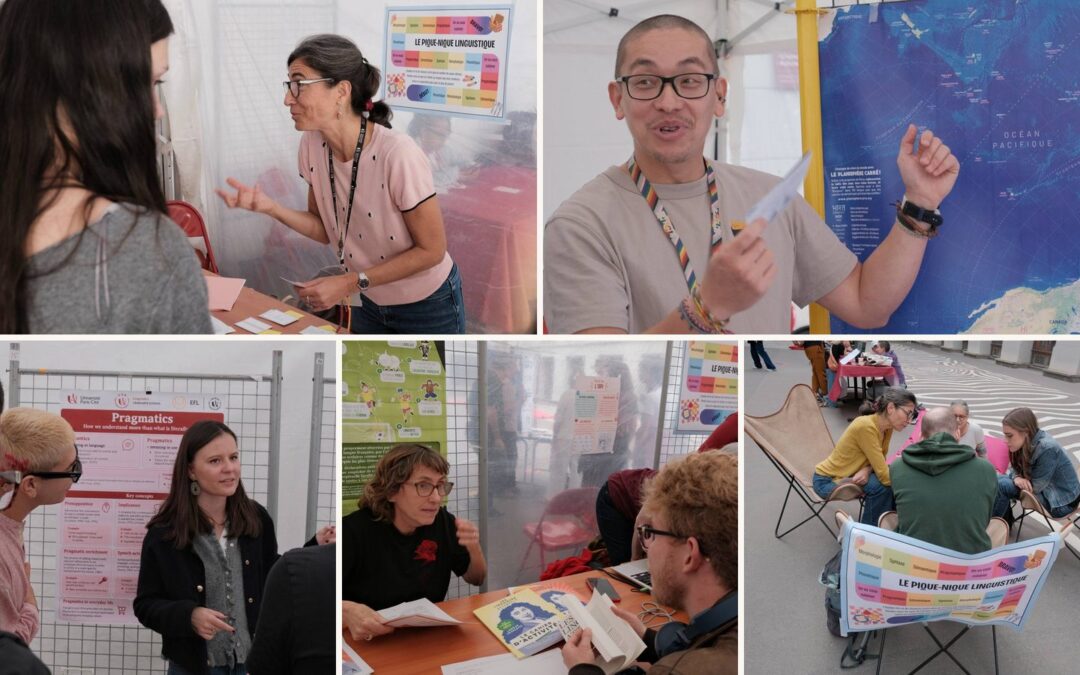
Fête de la Science 2026: EFL got languages talking
A sound map, a picnic, a quiz and an ultrasound of your tongue: for the Fête de la Science, the EFL project offered seven activities to discover linguistics through play, listening and experimentation. Lire la suite Fête de la Science 2026: EFL got languages talking
Thematic school “Conditionals – Theory, Typology, Diachrony and Corpora”
26–30 October 2026 | INALCO, Paris Lire la suite Thematic school “Conditionals – Theory, Typology, Diachrony and Corpora”
“Heritage language”: when the language of home meets the language of the street
A new episode of Linguodex, EFL’s podcast that defines the words of linguistics, one episode at a time. Lire la suite “Heritage language”: when the language of home meets the language of the street
EFL at the 2026 Fête de la Science
Join us at the Village des Sciences on October 2–3 Lire la suite EFL at the 2026 Fête de la Science