

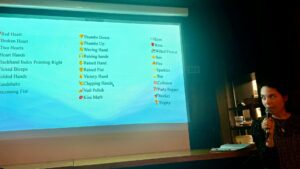
On May 19, 2026, Alicja Caban, a Master’s student at Université Paris Cité and member of the Paris Graduate School of Linguistics, presented the findings of her Master’s thesis at the Pint of Science festival, as part of an evening titled The Science of Connection. Her work, carried out in collaboration with Barbara Hemforth (LLF, CNRS – Université Paris Cité), co-leader of EFL’s Bilingualism and Multilingualism workpackage, was titled Emojis: How conventionalized are they really?
Emojis seem universal. Symbols like ❤️ or 👍 feel obvious, self-evident, shared by all. But is their interpretation really that straightforward?
The findings suggest that the meaning attributed to emojis is not uniform: it varies, among other factors, according to individual autistic traits. For people with higher autistic traits, non-face emojis — those that do not depict a face or facial expression — tend to feel more complex and less intuitive to interpret. What appears to be a transparent sign turns out, for a significant portion of users, to be a genuine source of ambiguity.
This research connects directly to the broader agenda of the EFL project, which studies language as it is actually used, in all its diversity. It also opens up concrete perspectives: understanding how linguistic conventions vary from one individual to another is a necessary step toward designing truly inclusive forms of digital communication.
Alicja Caban’s presentation at Pint of Science also reflects EFL’s commitment to training through research and to bringing scientific knowledge beyond the academic world.